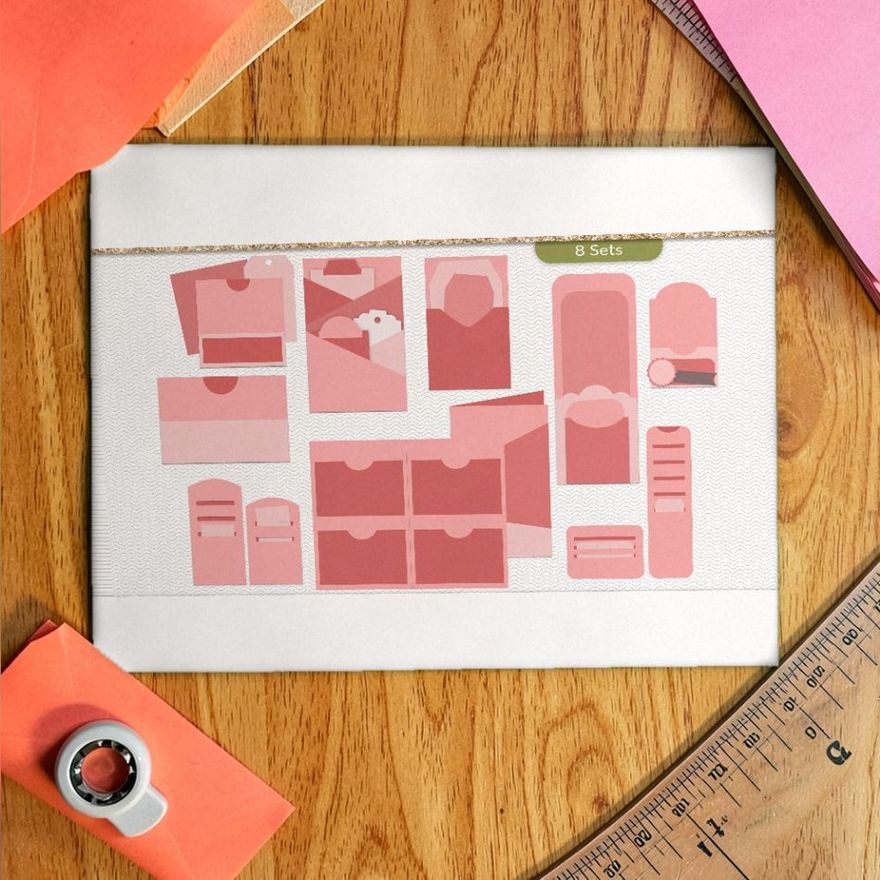


Pockets, tuck spots and flip-outs are what make a junk journal interactive: places to slip in tags, cards, letters and receipts, and extra panels that unfold beyond the page. The simplest ones take a minute. An envelope glued down on three sides is a pocket, a strip of paper glued at both ends is a tuck spot, and a folded sheet glued to the page edge is a flip-out. Below is how to make each, with sizes that fit a half-letter journal, and ideas for what to put inside.
Free Pockets and Journaling Cards
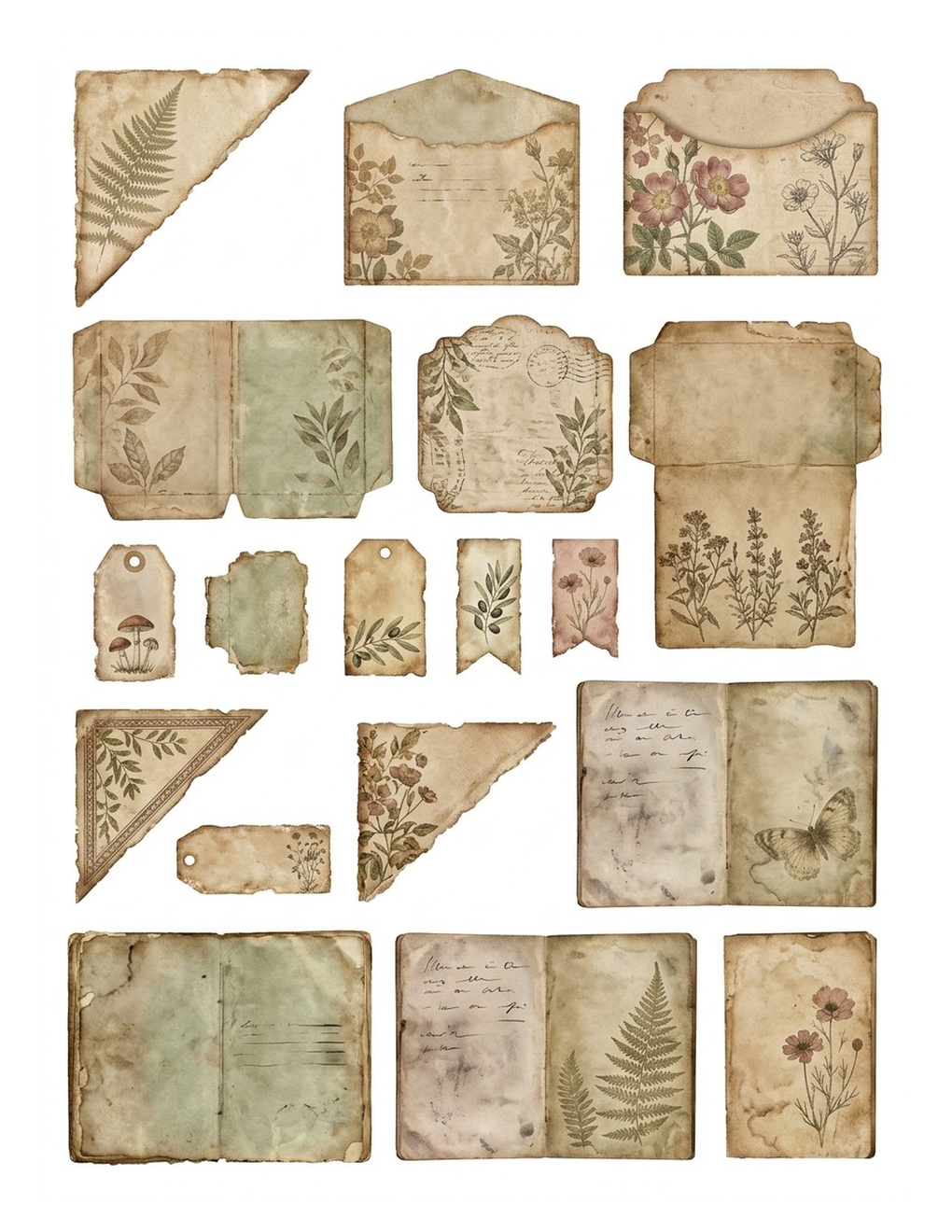
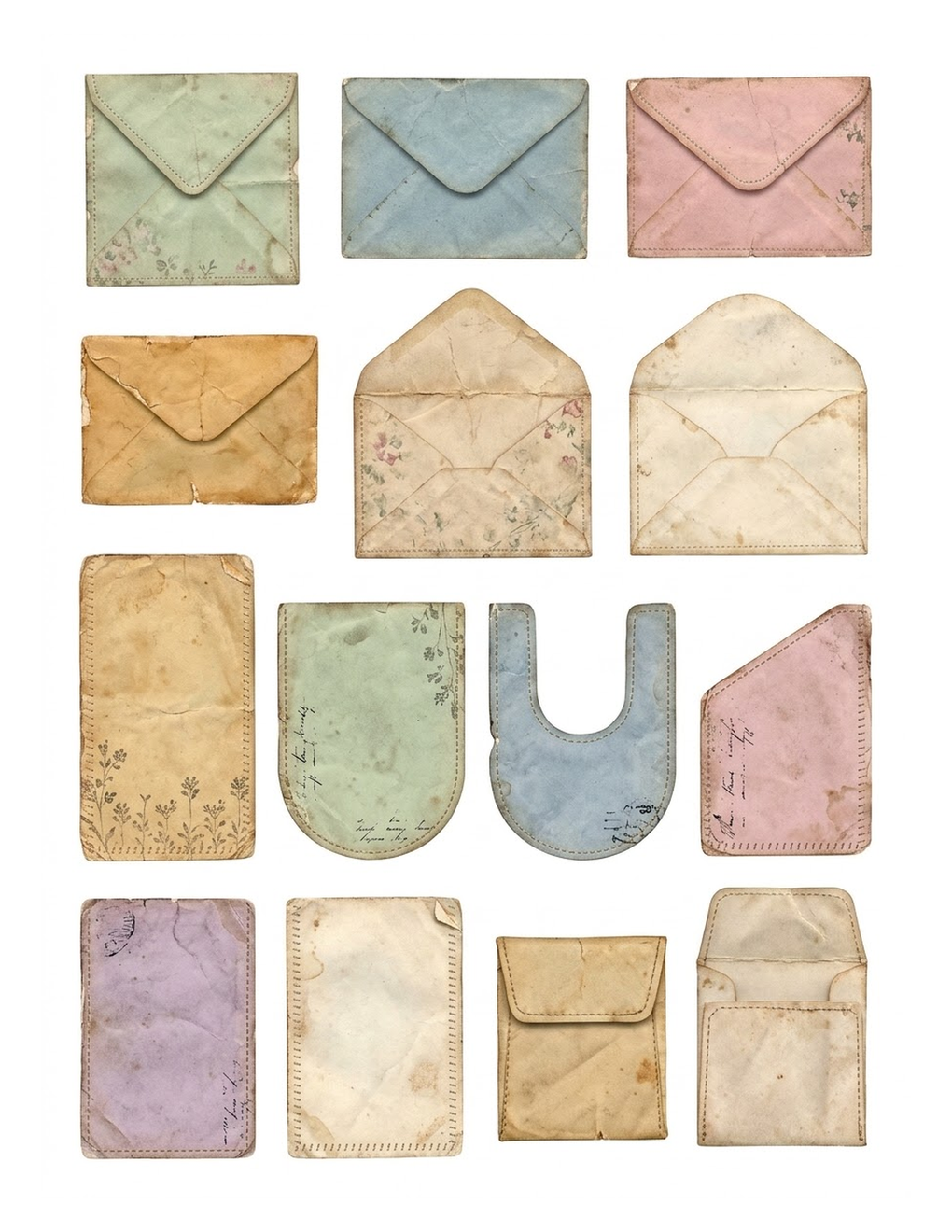
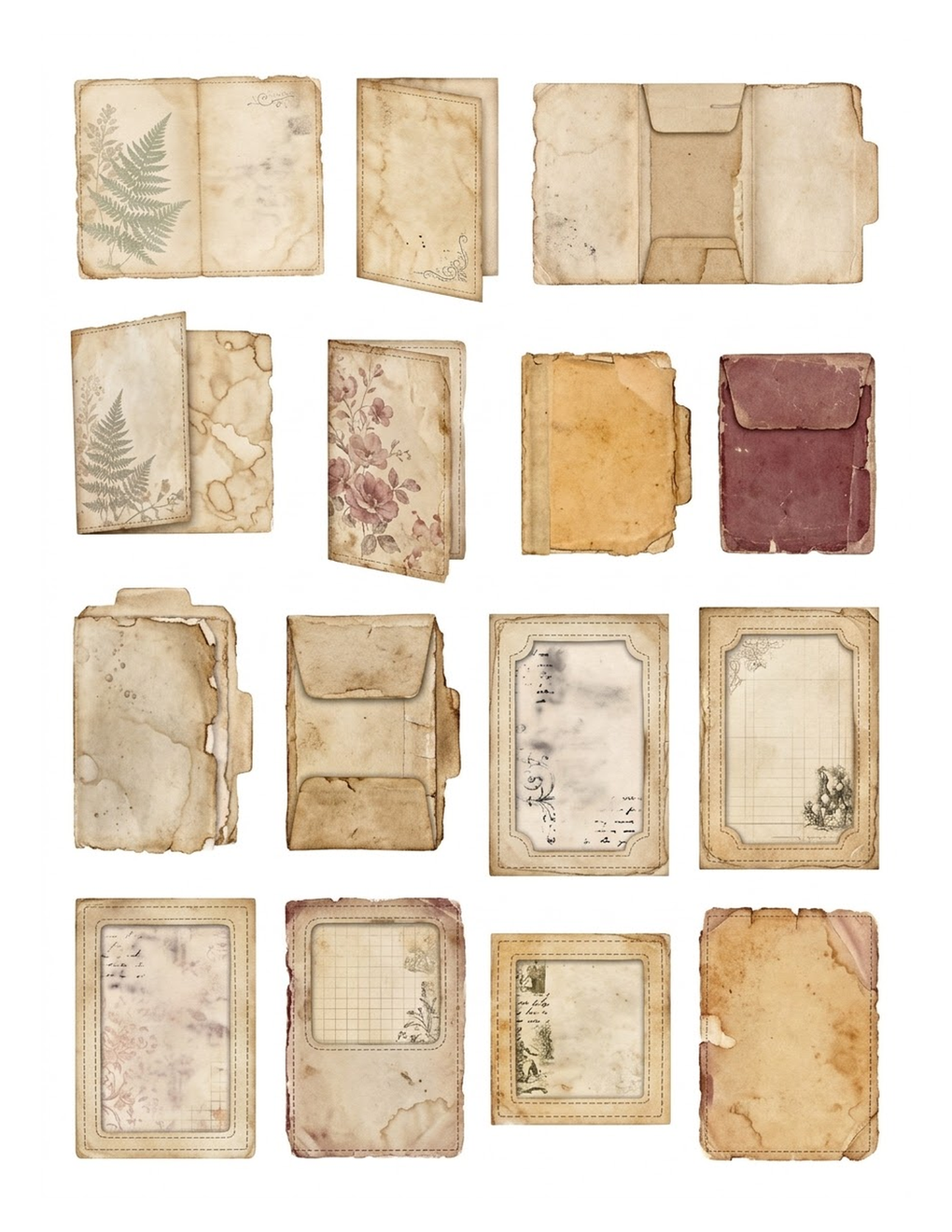
Here are three printable sheets to build tuck spots from: scalloped pockets and envelopes, blank journaling cards with frames, and small fold-outs and pull tabs. Cut, fold, stitch or glue, then slide the cards in.
Download all 6 pages in one PDFOne PDF of 6 pages. Pockets, cards and fold-outs.



Envelope Pockets
An envelope is a ready-made pocket. Glue it to the page with the flap open or cut off, and you have a deep pocket that holds cards securely.
To make one:
- Seal the envelope flap or trim it off, then cut the envelope across to the depth you want. A pocket of 3 to 4 inches deep is plenty for most tags.
- Glue the back of the envelope to the page, leaving the open end at the top.
- Decorate the front with a label, a stamp or a strip of vintage paper.
Sizes to know: a standard #10 business envelope is 4⅛ x 9½ inches, according to the printer 4OVER4. That is longer than a 5½ x 8½-inch half-letter page, so cut it in half across its length and you get two pockets about 4⅛ x 4¾ inches. An A7 envelope, 5¼ x 7¼ inches, fits on a half-letter page with a quarter inch to spare across the width and an inch and a quarter along the height.
Vintage-style envelopes from old bank or business mail, glassine envelopes and coin envelopes all make good pockets. Glassine is translucent, so whatever is inside stays partly visible.
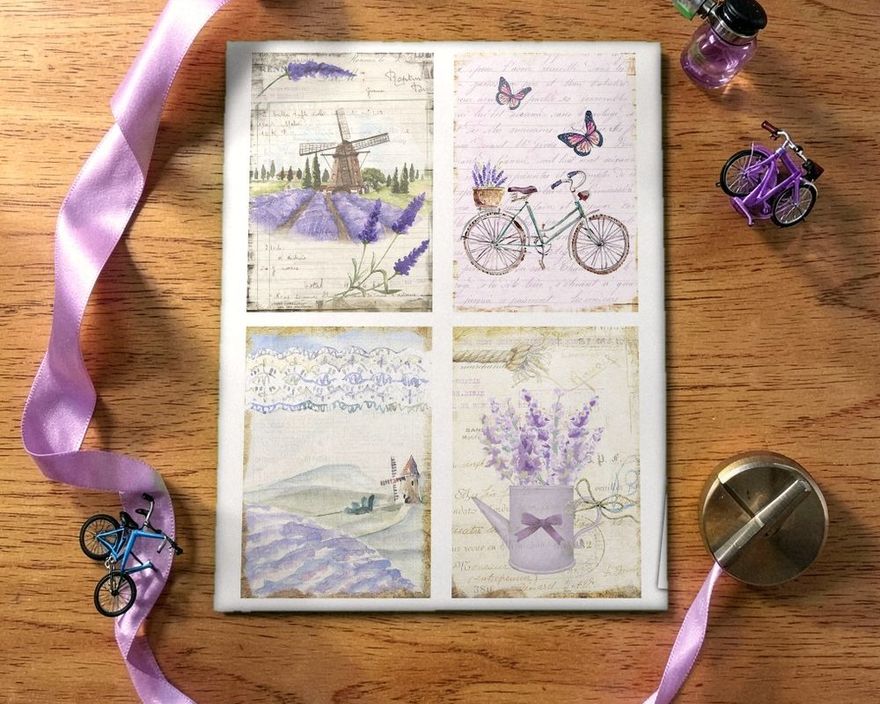
Library Card Pockets
The old library book pocket, with a card standing up out of it, is a junk journal favorite. You can make one from cardstock:
- Cut a rectangle about the width of your journal cards plus half an inch, and roughly twice as tall as the pocket you want.
- Fold up the bottom half to form the front of the pocket.
- Fold in two narrow tabs at the sides, a quarter inch is enough, and glue them behind the front.
- Glue the pocket to the page through its back panel and tabs.
Print a vintage library card design on cardstock to go inside, and the pocket instantly reads as "old library book." Pocket card templates take the measuring out of it:

Junk Journal Pocket Cards Template Kit
See the listing ↗
Sweet Birdie Library Journal Cards
See the listing ↗
Storybook Journal Cards and Pockets
See the listing ↗From the collection Journal Cards & Pockets. New Creative Fabrica members get 10 free downloads, and any of these can be one of them.
Belly Bands
A belly band is a strip of paper wrapped around a page or a whole signature, holding loose items against it.
- Cut a strip about 1½ to 2 inches wide and long enough to wrap around the page with half an inch of overlap.
- Wrap it around the page and glue the ends together at the back, not to the page itself, so the band can slide.
- Slide tags, cards or a folded letter under the band.
Belly bands work well on a single page cut from heavier paper, so the band does not crumple it. Decorate the front of the band with a label or a word.
Tuck Spots
A tuck spot is the simplest holder of all: a scrap of paper glued down along some of its edges, leaving a gap for a card to slip into.
- Corner tuck: cut a triangle from a scrap and glue it over a page corner along its two outer edges. The diagonal edge stays open.
- Strip tuck: glue a strip across the page at both ends only. Cards slide behind it.
- Doily or lace tuck: glue a paper doily or lace scrap along its bottom curve; the top edge becomes the opening.
- Photo corners: four corner tucks hold a card or photo that can be taken out.
Tuck spots are good uses for scraps that are too small for anything else, and they barely add bulk. For more ways to fit them into spreads, see junk journal ideas.

Flip-Outs and Tip-Ins
A flip-out is an extra panel attached to the edge of a page that unfolds outward.
- Take a sheet the same height as your page and up to twice its width.
- Fold it so that, when closed, it sits inside the page edge with about an eighth of an inch to spare, so it does not stick out of the book.
- Glue a narrow strip along one edge to the fore-edge of the page, or to the back of the page so it unfolds from behind.
Flip-outs double the space for a collage and are a good way to fit a large map, a long letter or a panoramic photo.
A tip-in is a single sheet, card or small booklet glued into the journal along a narrow strip at one edge, so it turns like an extra page. Use a strip of glue only about a quarter inch wide. Tip-ins are a neat way to add a smaller page, a vellum overlay or a mini booklet between full pages.
Build pockets and flip-outs onto pages before you sew the signature, where possible. Flat paper is easier to glue, and you can check that the pages still fold and close.
What to Put Inside
Pockets work best when their contents are worth pulling out.
- Journal cards for writing a few lines. Some are made in the 2½ x 3½-inch artist trading card (ATC) size; Strathmore notes that this size is the one official rule for ATCs, so journal cards and ATC-sized ephemera mix easily in the same pocket.
- Tags with a ribbon or string through the hole so they are easy to pull.
- Letters and notes folded small.
- Receipts, tickets and photos from the day the page is about.
- A mini booklet sewn with a single pamphlet stitch, as described in how to start a junk journal.
- Fussy cut flowers or labels standing up behind the card, peeking out of the pocket. Our fussy cutting tips explain how to cut them cleanly.
Printed tags come in useful shapes and sizes for pockets, and layered sets combine a tag with smaller labels to stack on it:
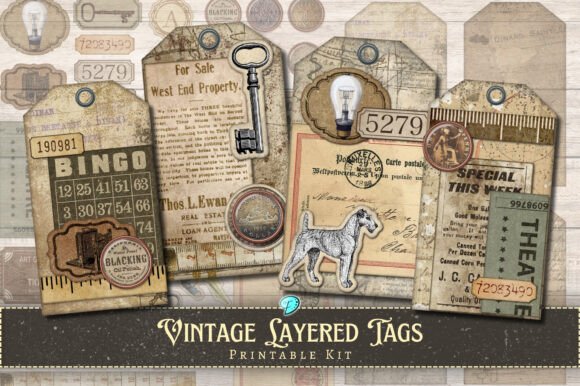
Vintage Layered Tags Printable Kit
See the listing ↗
Vintage Number Tags & Labels Craft
See the listing ↗
Vintage Sewing Gift Tags and Ephemera
See the listing ↗From the collection Vintage Labels & Tags. New Creative Fabrica members get 10 free downloads, and any of these can be one of them.
Keeping the Journal Closable
Every pocket adds thickness, and a journal full of pockets can refuse to close. A few ways to manage it:
- Spread pockets out across different signatures instead of stacking them on consecutive pages.
- Alternate sides: a pocket on the left page of one spread and the right page of the next.
- Add spine room: if you sew several signatures into one cover, make the spine wider than the pages need. Junk journal binding methods explains how.
- Use thin materials for pockets near the center of a signature, where bulk collects most.
Ready-Made Pieces for Pockets and Tuck Spots
You can fold every pocket from scrap, but a few ready-made envelopes and tags speed things up. A tape runner holds pocket edges without the moisture of wet glue.
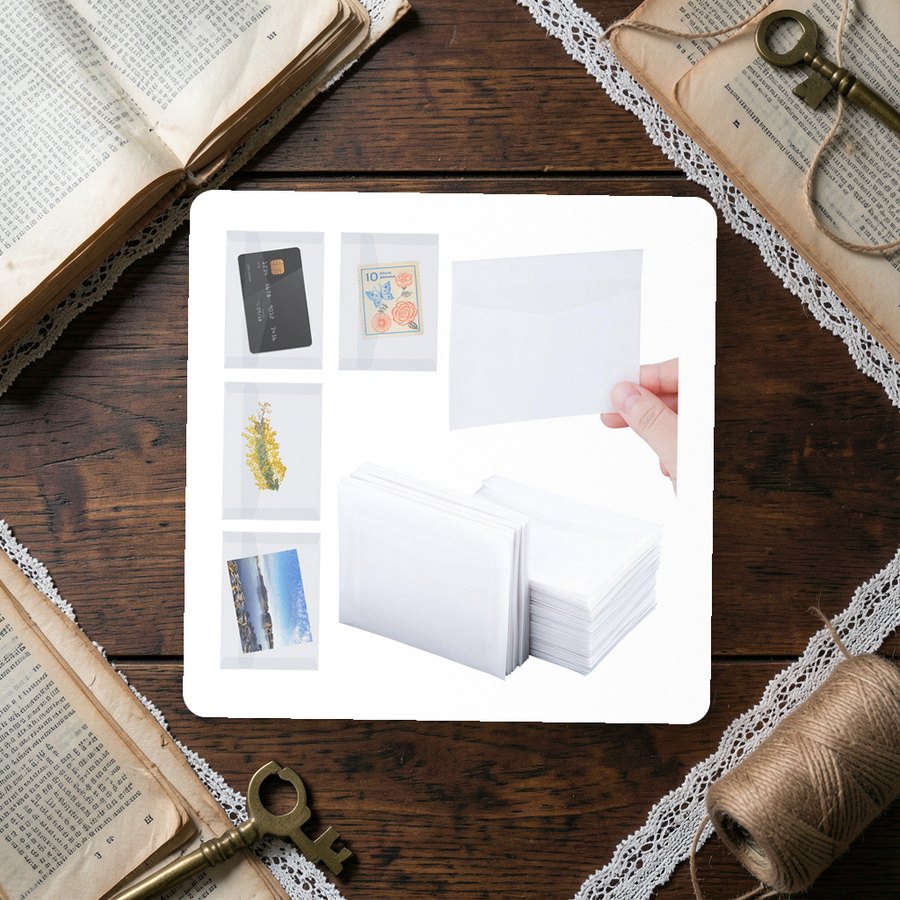 Small glassine envelopesAeaocvoSee it on Amazon
 Small kraft coin envelopesHomtableSee it on Amazon
 Kraft paper tags with stringKINGLAKESee it on Amazon
 Double-sided tape runnerScotchSee it on Amazon
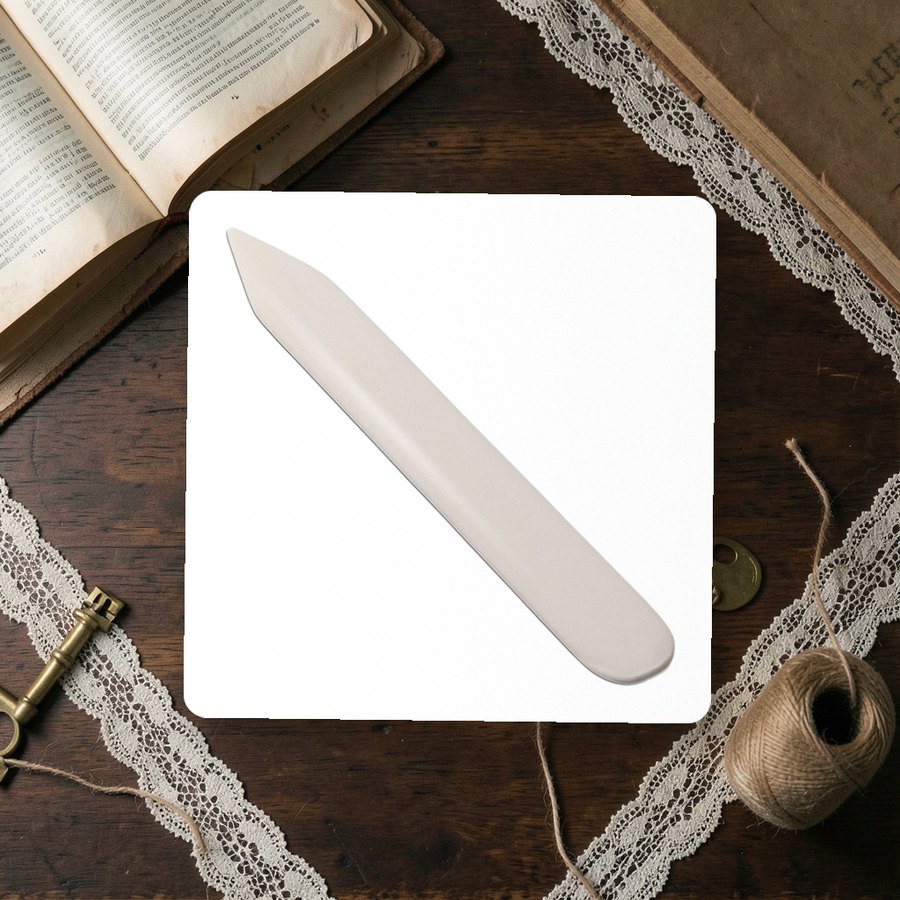 Bone folder for scoring and creasingVENCINKSee it on Amazon
As an Amazon Associate we earn from qualifying purchases.
Your Next Step
Make one of each: an envelope pocket, a library card pocket and a corner tuck, all in the same signature. Fill them with three journal cards and a tag. For cards and pockets that already match, look through the journal cards and pockets collection.
Papers for This Guide
Journal Cards & Pockets13 hand-picked · open the collection → Vintage Labels & Tags14 hand-picked · open the collection →


